
Student Achievement
West Kentucky Community and Technical College (WKCTC) uses its graduation rate, retention rate, and post-KCTCS outcomes each academic year to document student success.
Graduation Rate
Data Source: Integrated Postsecondary Education Data System (IPEDs); DSS Performance Measures Dashboard: CPE Strategic Agenda
- Definition: Cohort of first-time, full-time, credential-seeking undergraduates who complete their program within 150% of normal time as reported to the Integrated Postsecondary Education Data System (IPEDS).
- Target: Increase by .3 percentage points each year from the baseline.
- Minimum Threshold of Acceptability: To meet or exceed the KCTCS System Average.
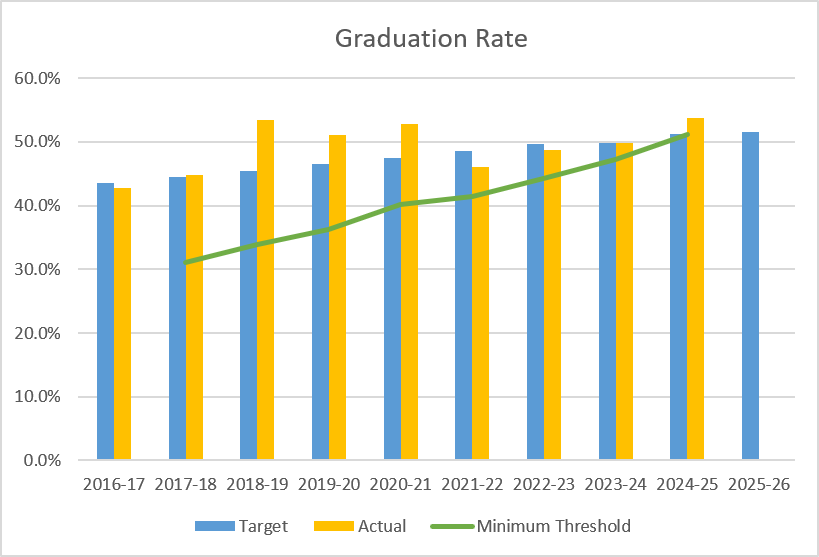
| Academic Year | Target | Actual | Minimum Threshold |
|---|---|---|---|
| 2016-2017 | 43.5% | 42.8% | |
| 2017-2018 | 44.5% | 44.8% | 31.0% |
| 2018-2019 | 45.5% | 53.4% | 33.9% |
| 2019-2020 | 46.5% | 51.1% | 36.3% |
| 2020-2021 | 47.5% | 52.8% | 40.2% |
| 2021-2022 | 48.5% | 46.0% | 41.5% |
| 2022-2023 | 49.6% | 48.7% | 44.2% |
| 2023-2024 | 49.9% | 49.8% | 47.2% |
| 2024-2025 | 51.2% | 53.7% | 51.1% |
| 2025-2026 | 51.5% | N/A | N/A |
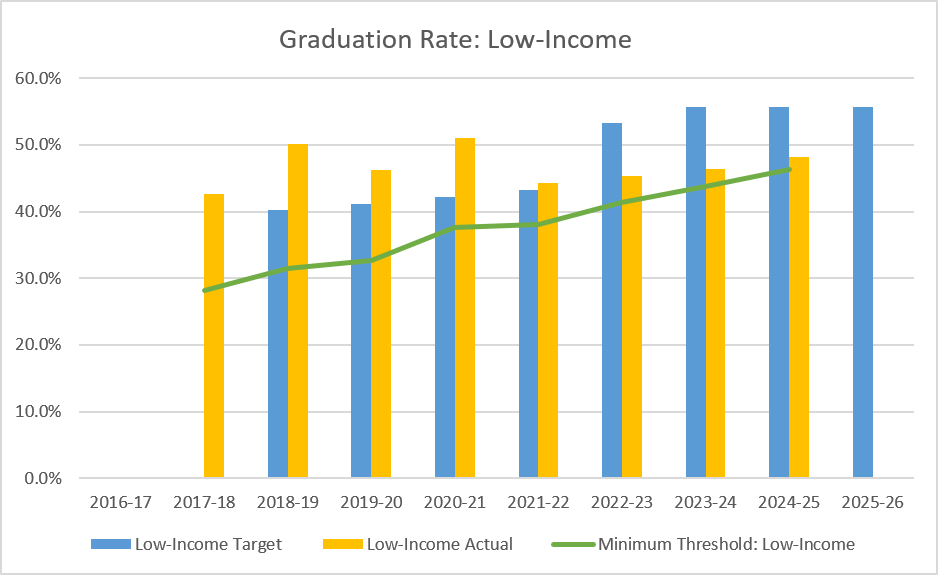
- Definition: Cohort of first-time, full-time, credential-seeking low-income undergraduates who complete their program within 150% of normal time as reported to the Integrated Postsecondary Education Data System (IPEDS). Low-income students are defined as those receiving a Pell grant in their first year.
- Target: Meet the targets as set by the Council of Postsecondary Education (CPE).
- Minimum Threshold of Acceptability: To meet or exceed the KCTCS System Average.
| Academic Year | Target | Actual | Minimum Threshold |
|---|---|---|---|
| 2017-2018 | N/A | 42.7% | 28.1% |
| 2018-2019 | 40.2% | 50.2% | 31.5% |
| 2019-2020 | 41.2% | 46.2% | 32.7% |
| 2020-2021 | 42.2% | 51.1% | 37.6% |
| 2021-2022 | 43.2% | 44.3% | 38.2% |
| 2022-2023 | 53.3% | 45.4% | 41.4 |
| 2023-2024 | 55.7% | 46.4% | 43.7% |
| 2024-2025 | 55.7% | 48.2% | 46.3% |
| 2025-2026 | 55.7% | N/A | N/A |
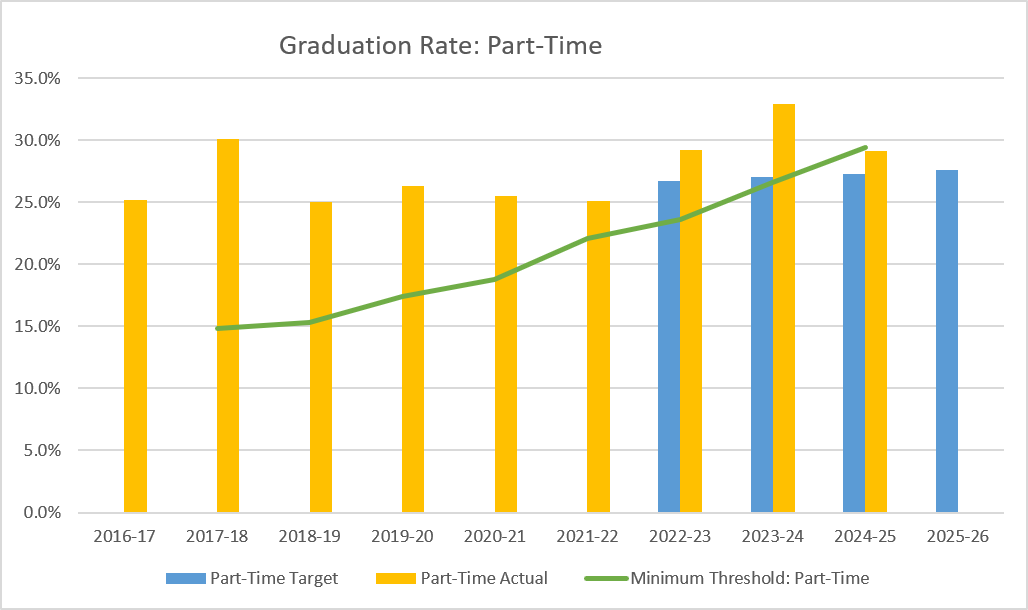
- Definition: Cohort of first-time, part-time, credential-seeking low-income undergraduates who complete their program within 150% of normal time as reported to the Integrated Postsecondary Education Data System (IPEDS).
- Target: Meet the targets as set by the Council of Postsecondary Education (CPE).
- Minimum Threshold of Acceptability: To meet or exceed the KCTCS System Average.
| Academic Year | Target | Actual | Minimum Threshold |
|---|---|---|---|
| 2016-2017 | N/A | 25.2% | N/A |
| 2017-2018 | N/A | 30.1% | 14.8% |
| 2018-2019 | N/A | 25.0% | 15.3% |
| 2019-2020 | N/A | 26.3% | 17.4% |
| 2020-2021 | N/A | 25.5% | 18.8% |
| 2021-2022 | N/A | 22.1% | 22.1% |
| 2022-2023 | 26.7% | 29.2% | 23.6% |
| 2023-2024 | 27.0% | 32.9% | 26.6% |
| 2024-2025 | 27.3% | 29.1% | 29.4% |
| 2025-2026 | 27.6% | N/A | N/A |
Retention Rate
Data Source: DSS Performance Measures Dashboard: CPE Strategic Agenda
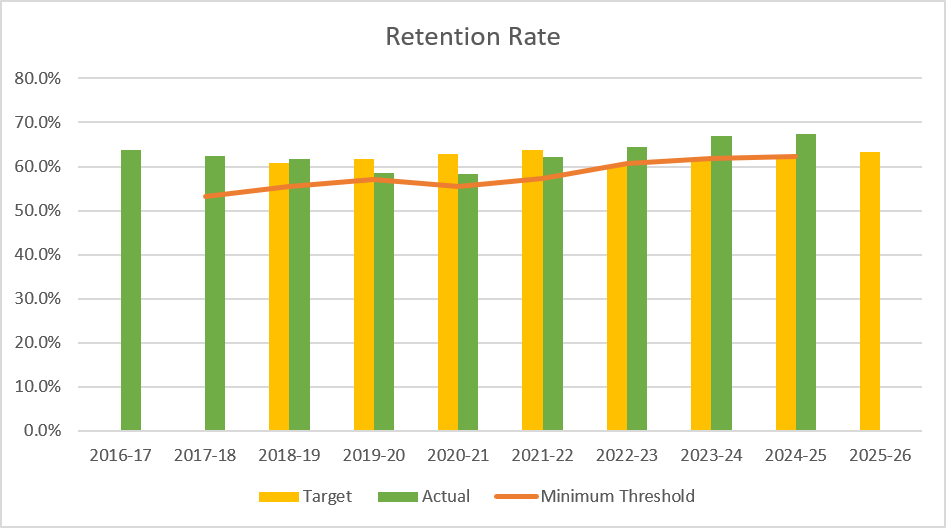
- Definition: Cohort of first-time credential-seeking undergraduates regardless of enrollment status who remain enrolled the subsequent fall semester as reported to IPEDs.
- Target: Increase retention by an average of 1 percentage point each year from the last five-year average.
- Minimum Threshold of Acceptability: To meet or exceed the KCTCS System Average.
| Academic Year | Target | Actual | Minimum Threshold |
|---|---|---|---|
| 2016-2017 | N/A | 63.8% | N/A |
| 2017-2018 | N/A | 62.5% | 53.3% |
| 2018-2019 | 60.8% | 61.8% | 55.5% |
| 2019-2020 | 61.8% | 58.6% | 57.1% |
| 2020-2021 | 62.8% | 58.2% | 55.5% |
| 2021-2022 | 63.8% | 62.2% | 57.7% |
| 2022-2023 | 60.3% | 64.3% | 60.8% |
| 2023-2024 | 61.3% | 66.9% | 61.9% |
| 2024-2025 | 62.3% | 67.5% | 62.2% |
| 2025-2026 | 63.3% | N/A | N/A |
- Definition: Cohort of first-time credential-seeking undergraduates who remain enrolled the subsequent fall semester as reported to IPEDs.
- Target: Increase retention by an average of 1 percentage point each year from the last five-year average.
- Minimum Threshold of Acceptability: To meet or exceed the KCTCS System Average.
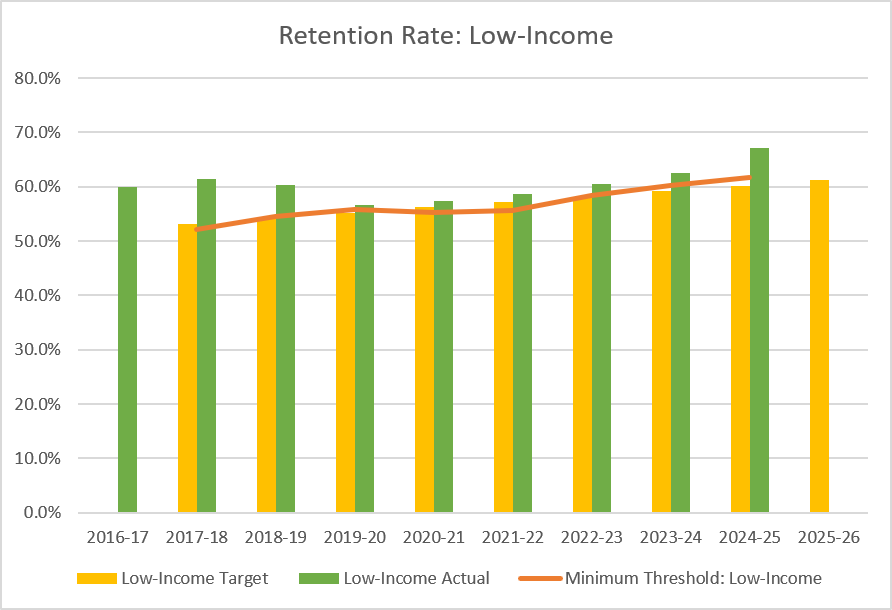
| Academic Year | Target | Actual | Minimum Threshold |
|---|---|---|---|
| 2016-2017 | N/A | 59.9% | N/A |
| 2017-2018 | 53.2% | 61.5% | 52.1% |
| 2018-2019 | 54.2% | 60.4% | 54.5% |
| 2019-2020 | 55.2% | 56.7% | 55.8% |
| 2020-2021 | 56.2% | 57.3% | 55.3% |
| 2021-2022 | 57.2% | 58.6% | 56.3% |
| 2022-2023 | 58.2% | 60.5% | 58.4% |
| 2023-2024 | 59.2% | 62.5% | 60.2% |
| 2024-2025 | 60.2% | 67.2% | 61.8% |
| 2025-2026 | 61.2% | N/A | N/A |
- Definition: Cohort of first-time, part-time credential-seeking undergraduates who remain enrolled the subsequent fall semester as reported to IPEDs.
- Target: Increase retention by an average of 1 percentage point each year.
- Minimum Threshold of Acceptability: To meet or exceed the KCTCS System Average.
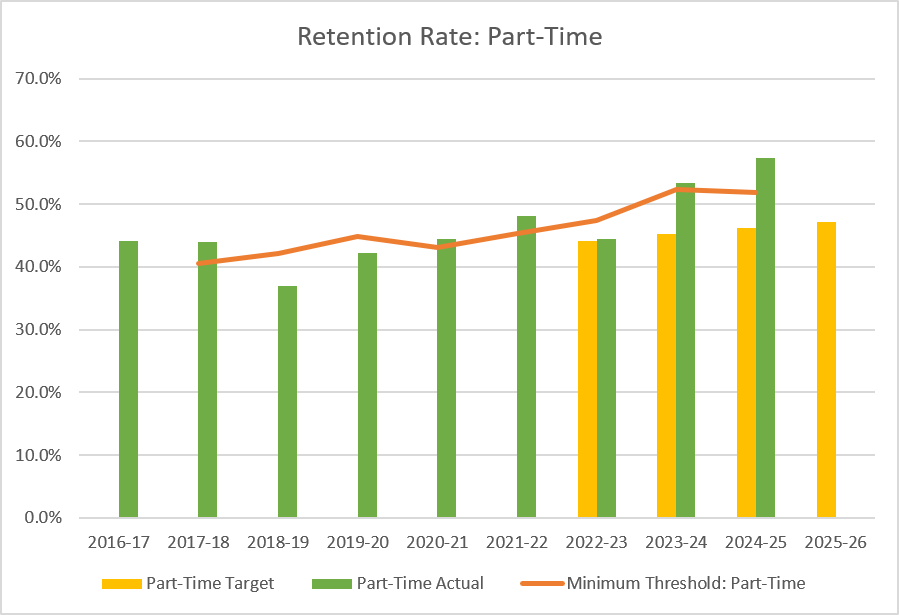
| Academic Year | Target | Actual | Minimum Threshold |
|---|---|---|---|
| 2016-2017 | N/A | 44.1% | N/A |
| 2017-2018 | N/A | 44.0% | 40.6% |
| 2018-2019 | N/A | 37.0% | 42.1% |
| 2019-2020 | N/A | 42.2% | 44.9% |
| 2020-2021 | N/A | 44.5% | 43.1% |
| 2021-2022 | N/A | 48.2% | 45.7% |
| 2022-2023 | 44.2% | 44.4% | 47.4% |
| 2023-2024 | 45.2% | 53.3% | 52.3% |
| 2024-2025 | 46.2% | 57.4% | 51.9% |
| 2025-2026 | 47.2% | N/A | N/A |
Post-KCTCS Outcomes
Data Source: Office of Research and Policy Analysis
- Definition: Non-returning credential earners in one academic year that enroll at a four-year institution or are employed in Kentucky and earn a wage greater than or equal to the federal poverty level the following academic year.
- Target: Increase by 0.8 percentage point each year.
- Minimum Threshold of Acceptability: 65%.
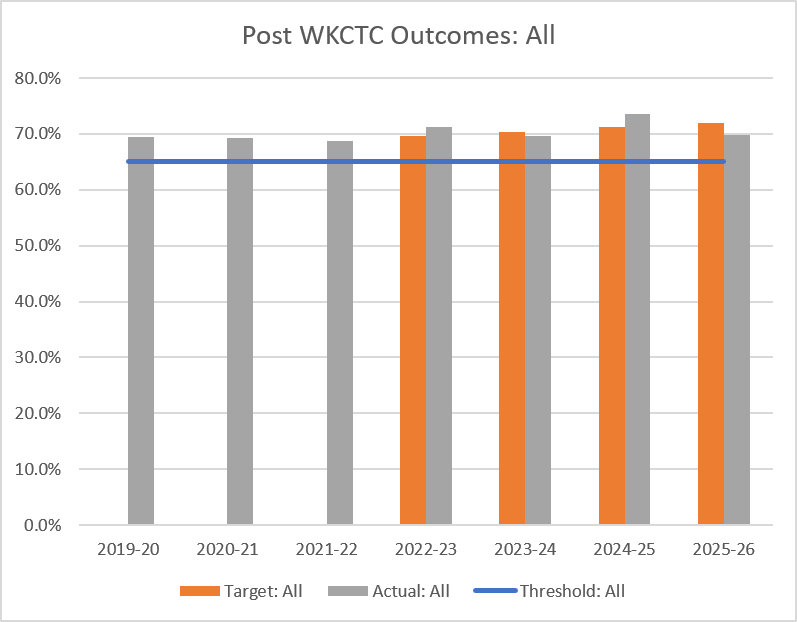
| Academic Year | Target | Actual | Minimum Threshold |
|---|---|---|---|
| 2019-2020 | N/A | 69.5% | 65.0% |
| 2020-2021 | N/A | 69.2% | 65.0% |
| 2021-2022 | N/A | 68.7% | 65.0% |
| 2022-2023 | 69.6% | 71.2% | 65.0% |
| 2023-2024 | 70.4% | 69.7% | 65.0% |
| 2024-2025 | 71.2% | 73.6% | 65.0% |
| 2025-2026 | 72.0% | 69.8% | 65.0% |
- Definition: Non-returning low-income credential earners in one academic year that enroll at a four-year institution or are employed in Kentucky and earn a wage greater than or equal to the federal poverty level the following academic year. Low-income students are defined as those receiving a Pell grant their first year.
- Target: Increase by 0.5 percentage points each year.
- Minimum Threshold of Acceptability: Meet or exceed the past five-year average of 65%.
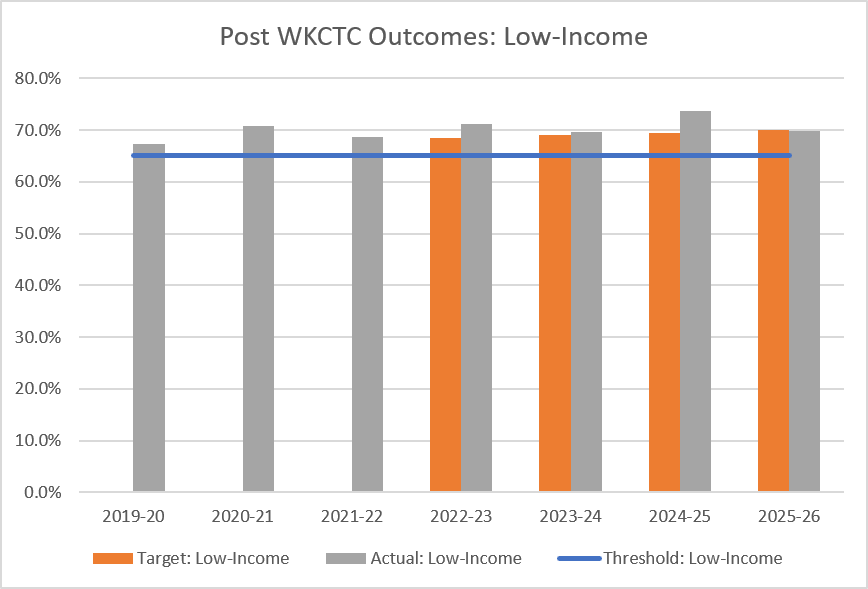
| Academic Year | Target | Actual | Minimum Threshold |
|---|---|---|---|
| 2019-2020 | N/A | 67.3% | 65.0% |
| 2020-2021 | N/A | 70.8% | 65.0% |
| 2021-2022 | N/a | 69.5% | 65.0% |
| 2022-2023 | 68.4% | 68.8% | 65.0% |
| 2023-2024 | 68.9% | 65.8% | 65.0% |
| 2024-2025 | 69.4% | 73.6% | 65.0% |
| 2025-2026 | 69.9% | 69.8% | 65.0% |
