
Outdoor Exhibits
Snap a photo with Luna Root, Silver Phoenix, or both and tag us on Facebook or Instagram—we’d love to see your visit!
 History
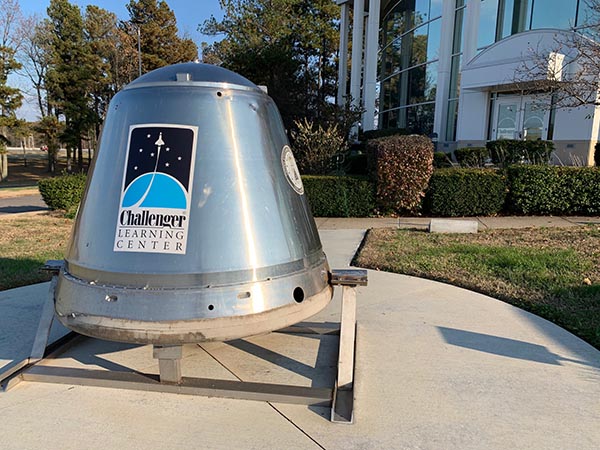
Due to its classified nature, the history of the nose cone has been difficult to piece together. We do know that it went to space sub-orbitally on an Atlas rocket as a test nose cone for the United States Air Force Intercontinental Ballistic Missile Program sometime between 1963 and 1965.
It arrived in Paducah around 1967 thanks to Colonel Harry (Hal) Hester, former commander of the Paducah Composite Squadron, Civil Air Patrol. It sat outside the CAP building for many years until it disappeared when the building was razed.
How did we get the nose cone?
In the fall of 2015, the nose cone was discovered in the McCracken County surplus yard and was going to be put up for public auction. The local squadron of Civil Air Patrol reclaimed possession of the nose cone and immediately donated it to the Challenger Learning Center so it would remain in Paducah. The nose cone arrived on the WKCTC campus a few days later and was then put on permanent display in its current location in the spring of 2016.
How did the nose cone get its name?
In 2016, to involve school children in the excitement of our new piece of history, the Challenger Learning Center held a name the nose cone contest. From over forty entries, the name chosen was created by Cody Peterson, a fifth grader at Sharpe Elementary School in Marshall County, Kentucky. He chose the name Silver Phoenix, because like the mythological phoenix being reborn, the nose cone is a piece of history that has been reborn as a beautiful display outside the center.
History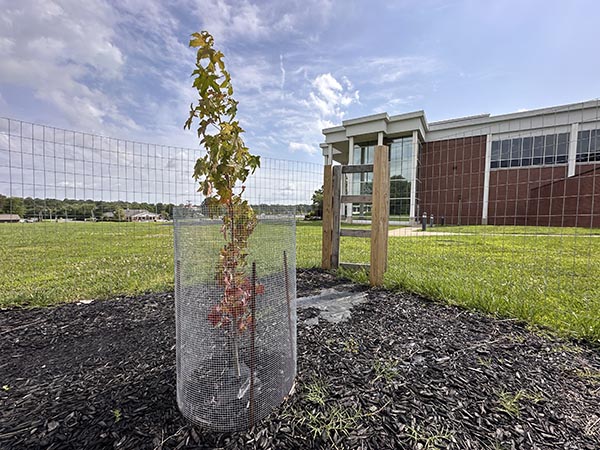
Artemis Moon Trees, the second generation of “Moon Trees,” are seedlings grown from approximately 1,200 seeds that orbited the Moon on the 2022 NASA Artemis I mission. The seeds traveled 1.4 million miles aboard the Orion spacecraft that launched on November 16, 2022, and returned to Earth on December 11, 2022. The seeds included five species: Douglas-fir, loblolly pine, giant sequoia, American sycamore, and sweet gum. The original moon tree seeds were flown by astronaut Stuart Roosa on Apollo 14 in 1971.
In collaboration with the USDA Forest Service, these seeds were germinated into hundreds of seedlings to be distributed to schools, museums, and communities. These trees are meant to inspire interest in the STEM fields, environmental stewardship, and connect communities to the Artemis program’s goal of returning humans to the Moon.
How did we get an Artemis Moon Tree?
The Challenger Learning Center at Paducah applied to NASA to be an Artemis Moon Tree recipient in 2023. We were awarded a precious little sweet gum seedling that landed at our center in the fall of 2024. The sweet gum is a hardy species chosen specifically for our growing region. She has survived our crazy weather and is now a well-established sapling!
How did the tree get its name?
After surviving her first winter, we held a naming contest in 2025 for the moon tree. Area students and community members were encouraged to submit a name for the tree along with a brief description of the meaning of the name. The top three submission choices were put to a public vote, and our Artemis Moon Tree officially became Luna Root. Cara Torres, a sixth grader at Heath Middle School, submitted the winning entry. Cara stated the name she created tells the story about both parts of its journey. Luna means moon, which is where the seed traveled. Root is now what is growing in our Kentucky soil. It shows that something so small can go far into space but still come home to grow.
